Any machine that transforms any form of energy (chemical, electrical) into mechanical work transmitted through the way of his body (motor shaft) is called a motor. The internal combustion engine is the mechanically unit within which combustion occurs. Mechanical work is obtained throught the heat of combustion.
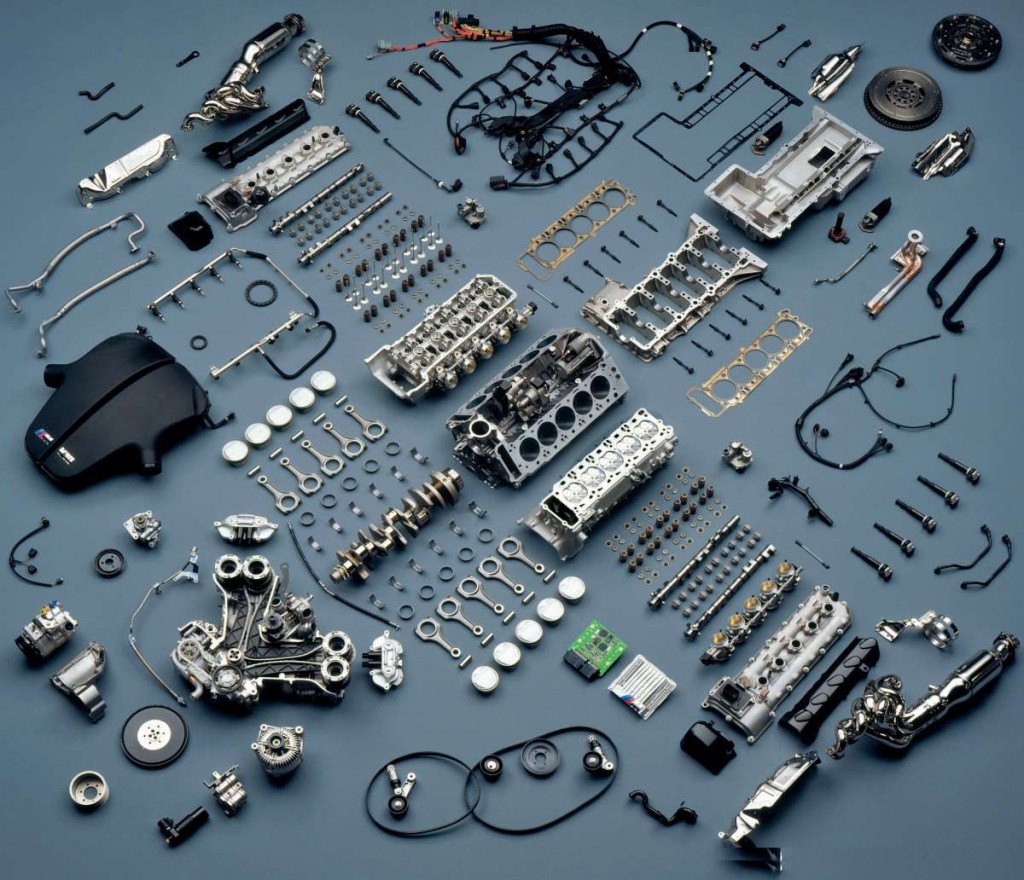
[styled_image w=”500″ h=”300″ lightbox=”yes” align=”center” alt=”disassembled (exploded view) of engine” caption=”BMW V8 motor” image=”https://automobilesoft.net/wp-content/uploads/2014/08/motors-overview.jpg”]
[clear]
Diesel or gasoline engines operate on a white-crank principle.
What this means? According to this principle, the bell-crank mechanism is designed to distribute the reciprocating movement of the pistons in the rotation movement of the crankshaft.
The internal combustion engine has the following systems or components:
[bullet_list class=”icon-flag” color=”#3E9FA3″ size=”large”]
- mobile mechanism (piston, connecting rod, crankshaft)
- fixed parts (engine block, cylinder head, oil sump)
- air intake system (intake manifold, turbo compressor, filter)
- exhaust system (exhaust manifold, muffler)
- gas distribution systems (camshafts, valves)
- fuel system (pump, injector, filter)
- grease lubrication system (pump, filter)
- petrol ignition system (ignition coil, spark plugs)
- electrical system (starter, alternator)
- auxiliary systems (cooling, air conditioning)
[/bullet_list]
See the Diesel Engine and Gas Engine!
Other articles you may like…
[portfolio category=”5″ columns=”3″ posts_per_page=”3″ paging=”false” content_width=”572″ image_ratio=”7:4″ title=”Yes” excerpt=”Yes” excerpt=”false” excerpt_length=”9″ link=”post” orderby=”rand”]
I found a lot of interesting things on this site.